

For leaders managing software teams based in the Indian subcontinent serving North American firms
North America–ready communication for your India-based software teams.
The communication drag you’ve accepted as ‘normal’ with offshore teams is not inevitable—and it’s costing you more than you think.
Overcoming Challenges
When your offshore team misses the mark...
Bridge the gap between your carefully crafted instructions and their actual implementation.

"Why didn't they just ask?"
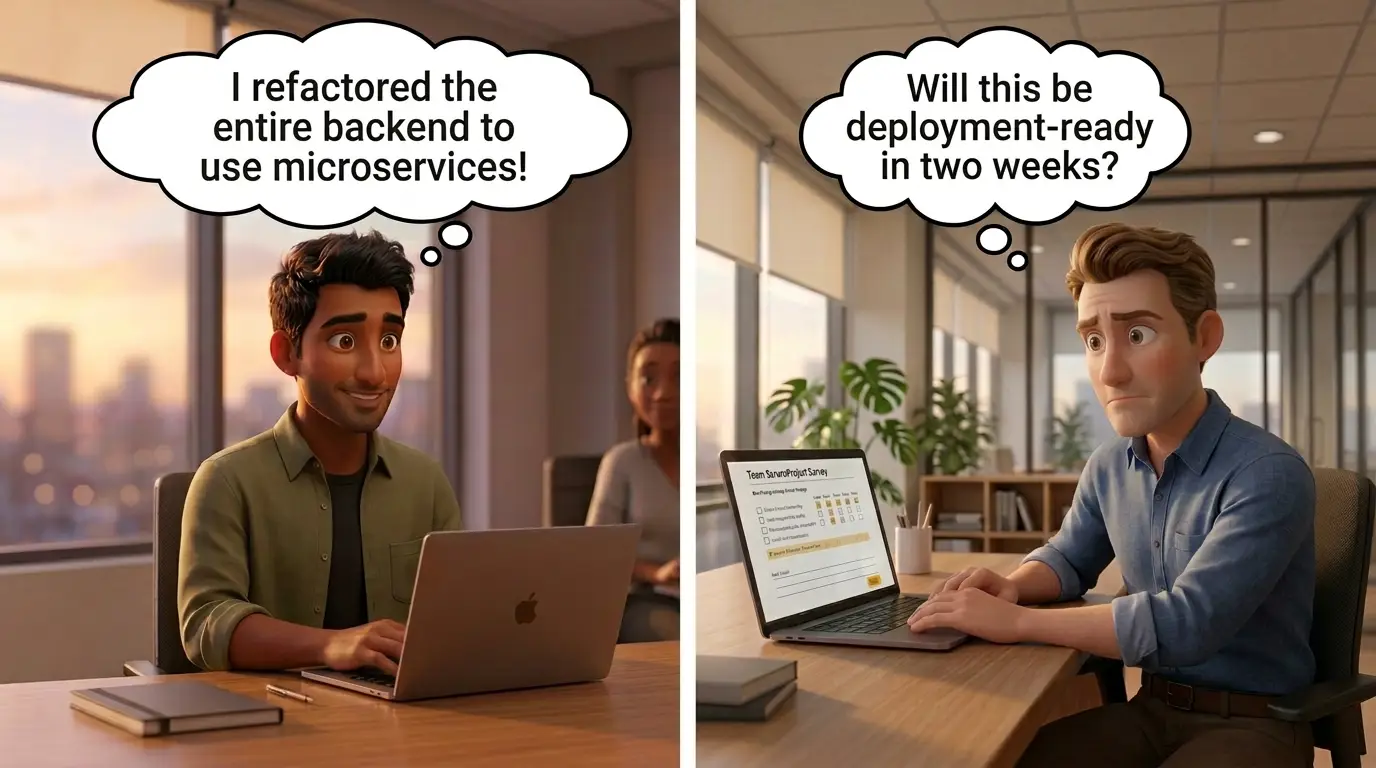
When offshore staff hesitate to clarify, confusion grows, and mistakes compound. There's a mindset shift needed (reinforced with practice) to know that being direct and proactive is desirable, not disrespectful. I help your team ask the right questions before things go off track.

"I thought I was clear…"
Fast-paced meetings and indirect language often leave offshore teams confused while also too hesitant to ask for clarity. I help your team develop strategies to confirm instructions clearly and keep projects moving forward.

"I never know where things stand…"
When offshore teams avoid proactive updates, managers are left guessing; unsure if tasks are progressing or if blockers are emerging. I train your team to provide clear, timely updates that keep projects on track.
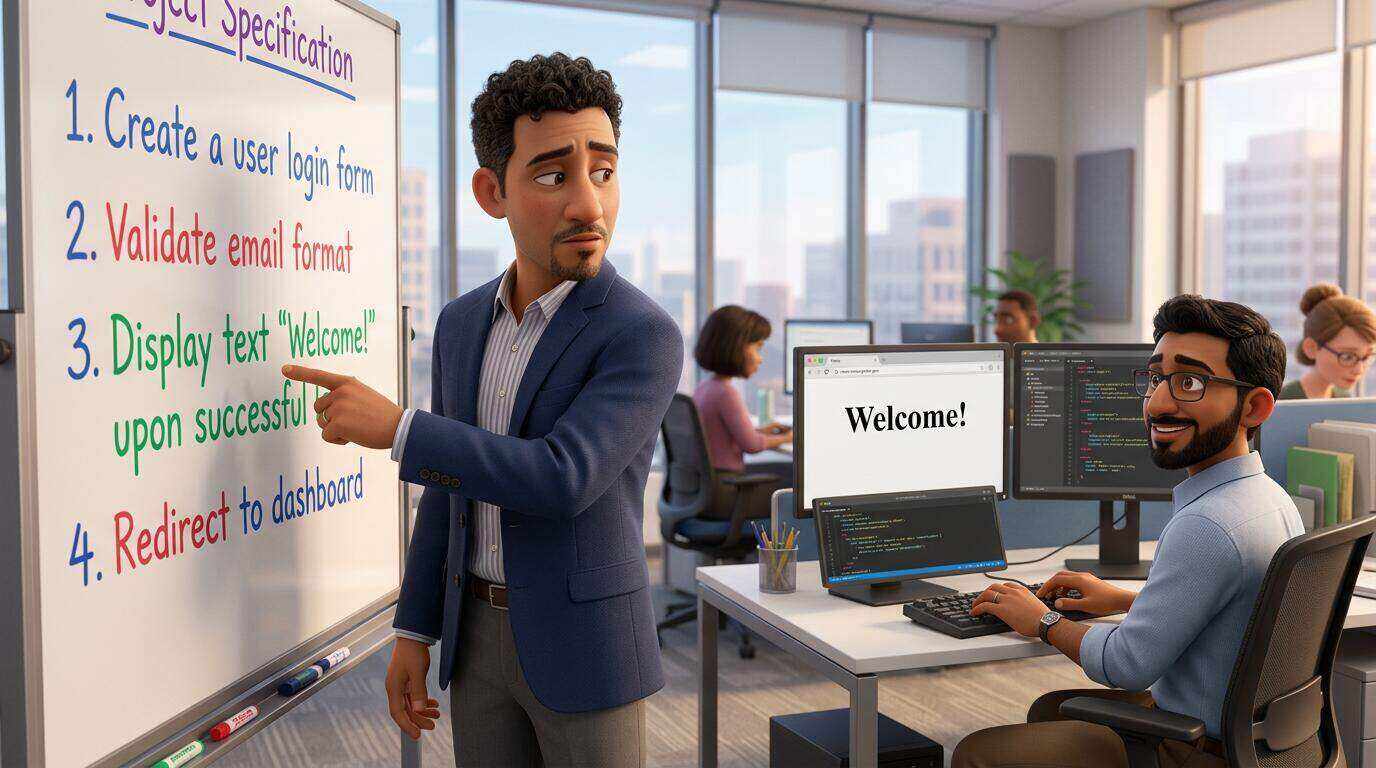
"They only do exactly what I ask"
When requirements are ambiguous or priorities shift, you need team members who adapt and problem-solve, not wait for step-by-step instructions. I train your team to take ownership, exercise judgment, and act with initiative.
These are just the patterns that surface first.
The full program goes deeper: helping your team build the judgment, confidence, and ownership to solve problems more independently, navigate ambiguity, and operate with greater autonomy. Eight modules, delivered over 12 weeks. AI-powered practice. Tailored feedback, not generic scripts.
Explore North America Ready



What the Research Says
They're typically called 'soft skills,' but I think that's a misnomer. 'Soft' feels like it's less important. I think they're more important than ever.
— Ryan Roslansky, CEO of LinkedIn, The Fastest-Growing Jobs in the AI Era (2026)






How It Works

Baseline where your team is at
Two short, confidential surveys: one for your North American stakeholders on where communication breaks down most, and one for your offshore team members on what they feel holds them back. Neither side sees the other's responses. We aggregate the patterns and share them with you so you see the full picture before training begins. Not just one perspective. Takes 15 minutes per person, zero disruption.
We survey both sides, your stakeholders and your team, because the root causes don't always come from where you'd expect. Sometimes what's holding your team back isn't a skills gap but a local management dynamic, conflicting guidance, or an environment that discourages the very behaviors you're trying to develop. We surface those patterns so you're not blindsided, and so the training targets what actually needs to change.
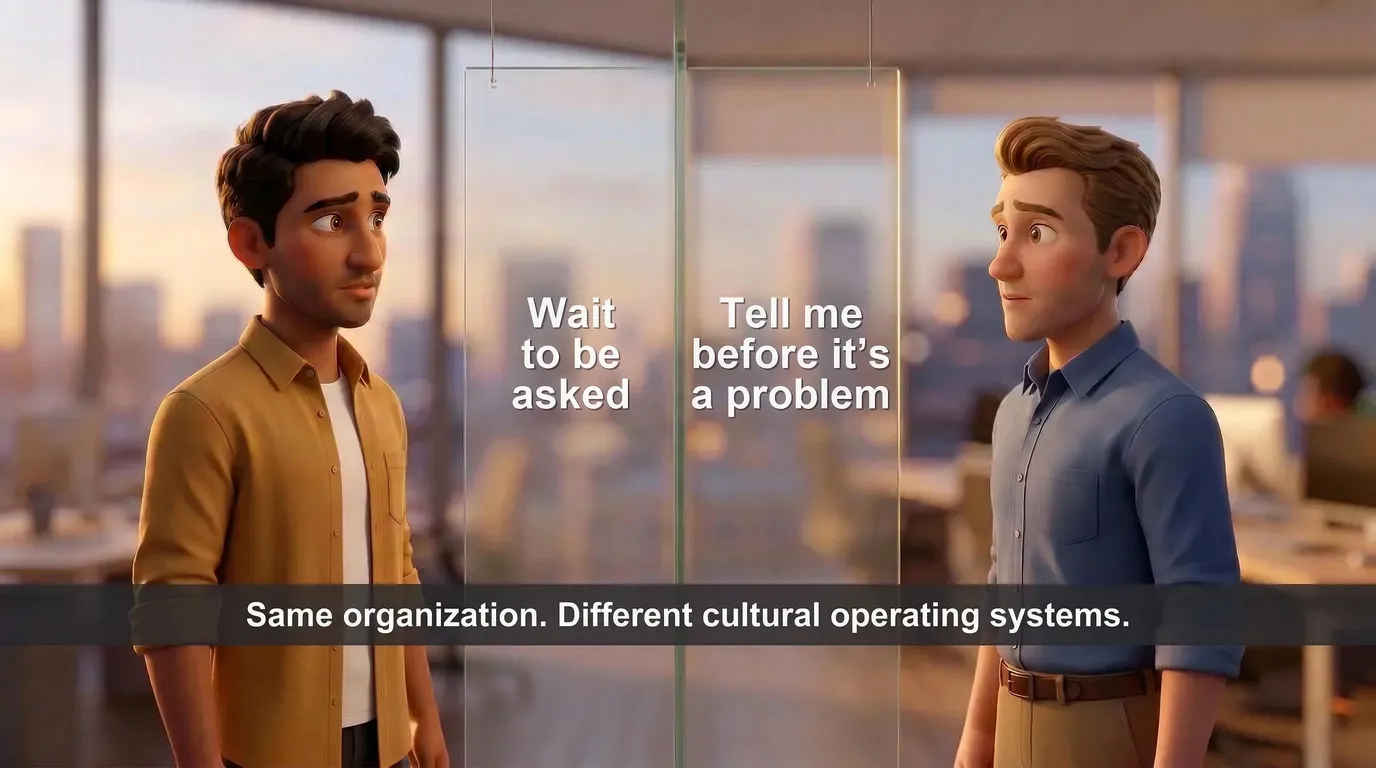
See why the gap keeps happening
Your team learns what cultural dimensions actually drive the friction: why questions don't get asked, why bad news arrives late, why meetings go silent, why feedback feels one-directional. We ground this in cultural intelligence research, not guesswork. When your team sees that their defaults come from deeply ingrained norms around hierarchy, conflict avoidance, and indirect communication, not a lack of ability, they stop second-guessing themselves and start adapting with purpose.
Get structured techniques for every situation
Each topic comes with actionable approaches your team can follow immediately, not vague advice like "be more direct" or "speak up more." Whether it's flagging a risk before it spirals, leading a meeting instead of sitting through one, making conversation with a client before a call starts, negotiating a timeline they can actually hit, or presenting work to senior stakeholders, they walk away with specific moves they can use that same week.

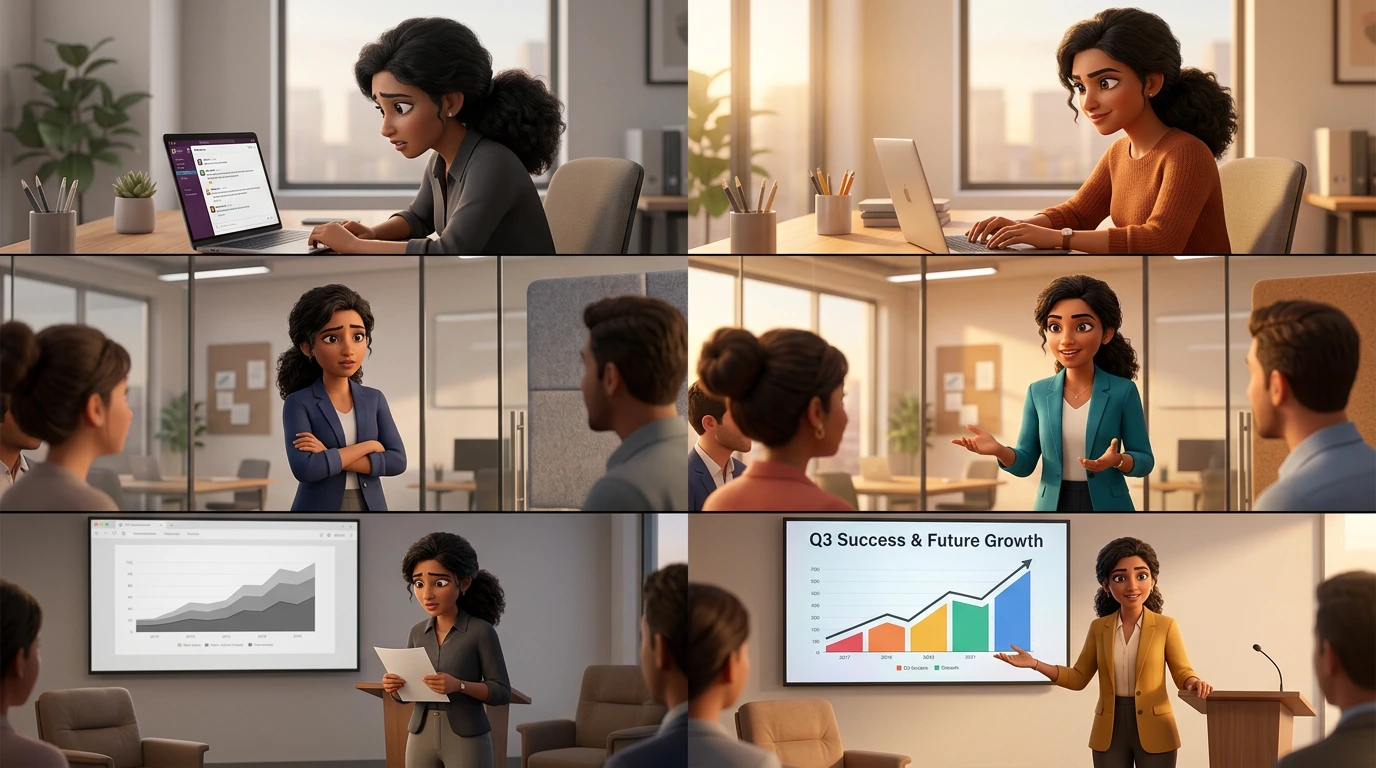
See the contrast in real scenarios
Before-and-after examples drawn from the situations your team actually faces: a standup update that buries the lead vs. one that opens with the blocker. A status email that hedges vs. one that's clear. A meeting where nobody pushes back vs. one where someone raises a concern with empathy. A presentation intro that apologizes vs. one that commands attention. Your team sees the old pattern next to the new one, in contexts they recognize. That's when the shift clicks.
Practice the hard conversations live
Live sessions where your team role-plays the exact scenarios that create friction on your projects: delivering bad news to a PM before a deadline slips, pushing back on scope with empathy, presenting to a skeptical client, navigating a disagreement with a peer, making small talk with a stakeholder they've never met. Immediate feedback from peers and practice tools. Not theory. Reps. This is where the cultural intelligence from Step 1 becomes muscle memory.


AI-powered practice — in class and beyond
During live sessions, each team member gets personalized AI feedback on their own performance, so even in a group setting, the coaching is individual. They rehearse conversations, refine how they phrase updates, practice presentation openings, and get scored on the specific behaviors that matter for their role. Anyone who wants extra reps can keep practicing between sessions — private, self-paced, no homework pressure. The reps are there for those who want them.
This approach repeats for every topic, from navigating cultural differences and asking clarifying questions to improving English precision, building rapport, handling workplace scenarios, and delivering presentations. Each round builds on the last.

Measure the shift
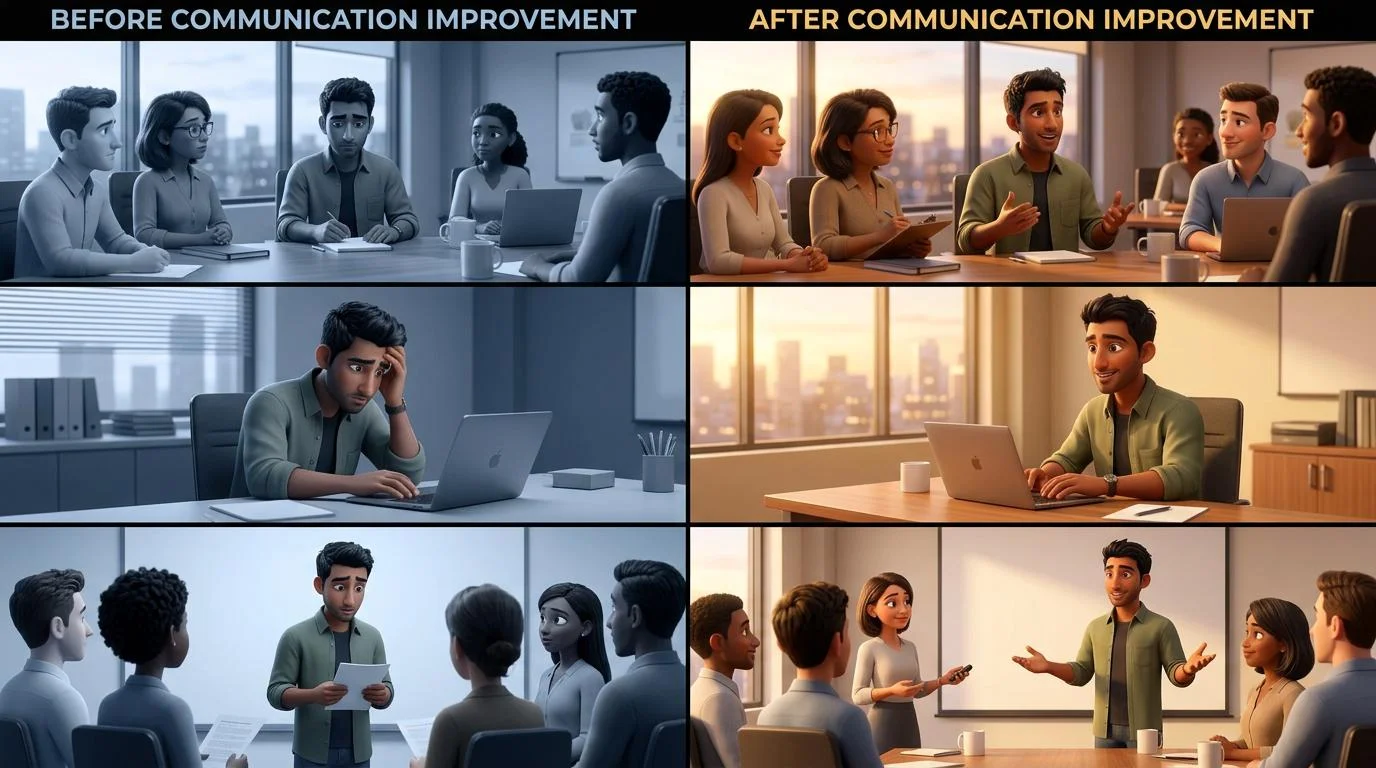
We run both surveys again after the program. You see the behavioral change from your stakeholders' perspective, and you see whether the barriers your team reported at the start have shifted. Not just satisfaction scores. Your managers confirm what's different in day-to-day work.



The Business Case
Overview of the Program:
The North America Ready program is designed to close the communication gaps that cause rework cycles, missed requirements, and margin burn in offshore delivery.
Navigating Cultural Differences
Asking Clarifying Questions
Level Up Your Team's English
Building Rapport with Small Talk
Navigating Work Scenarios
Delivering Effective Presentations
The Competitive Edge
The AI Communications Toolkit
What Changes for Your Team
After North America Ready
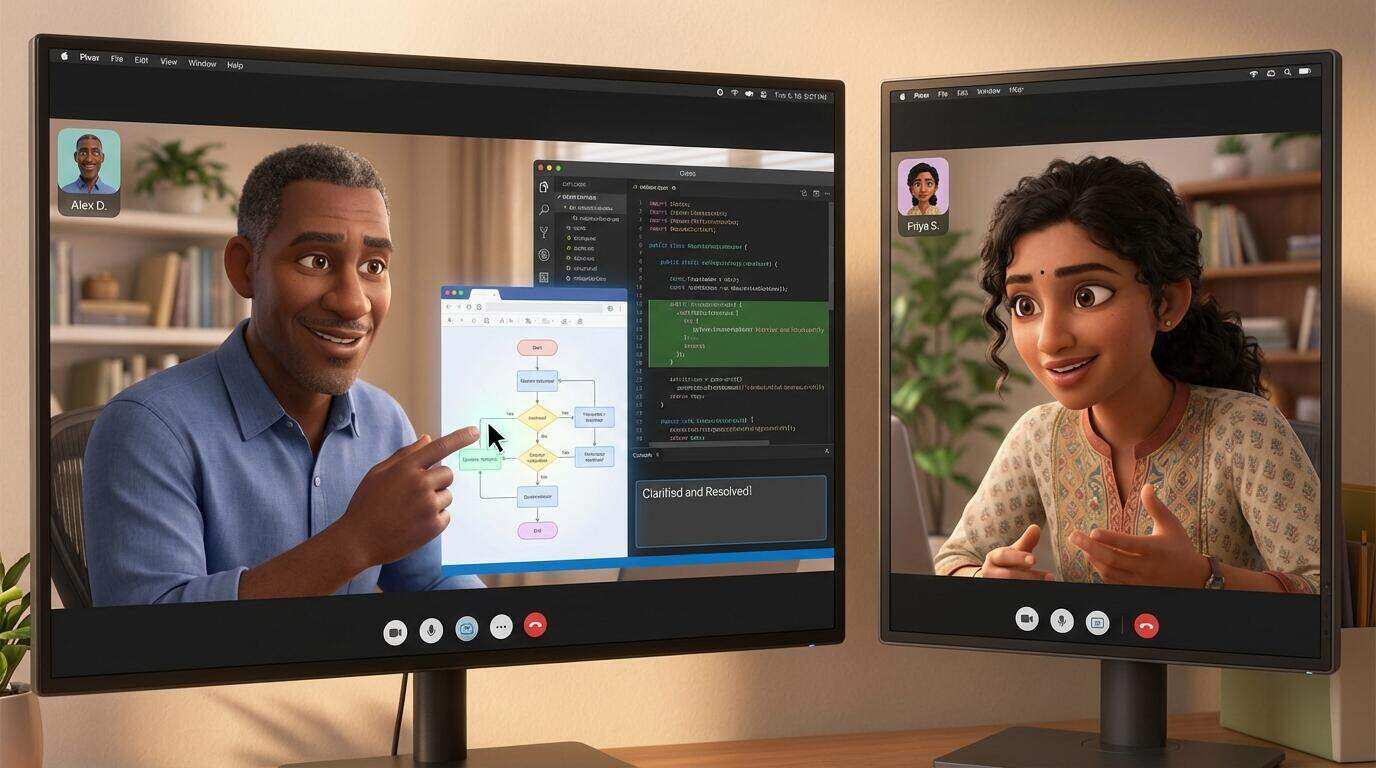
Experience Fewer Costly Mistakes
Your offshore team will confidently ask clarifying questions when requirements are unclear, identify potential issues early, and communicate their understanding explicitly.
This reduces misunderstandings that delay projects, require costly rework, and frustrate teams.
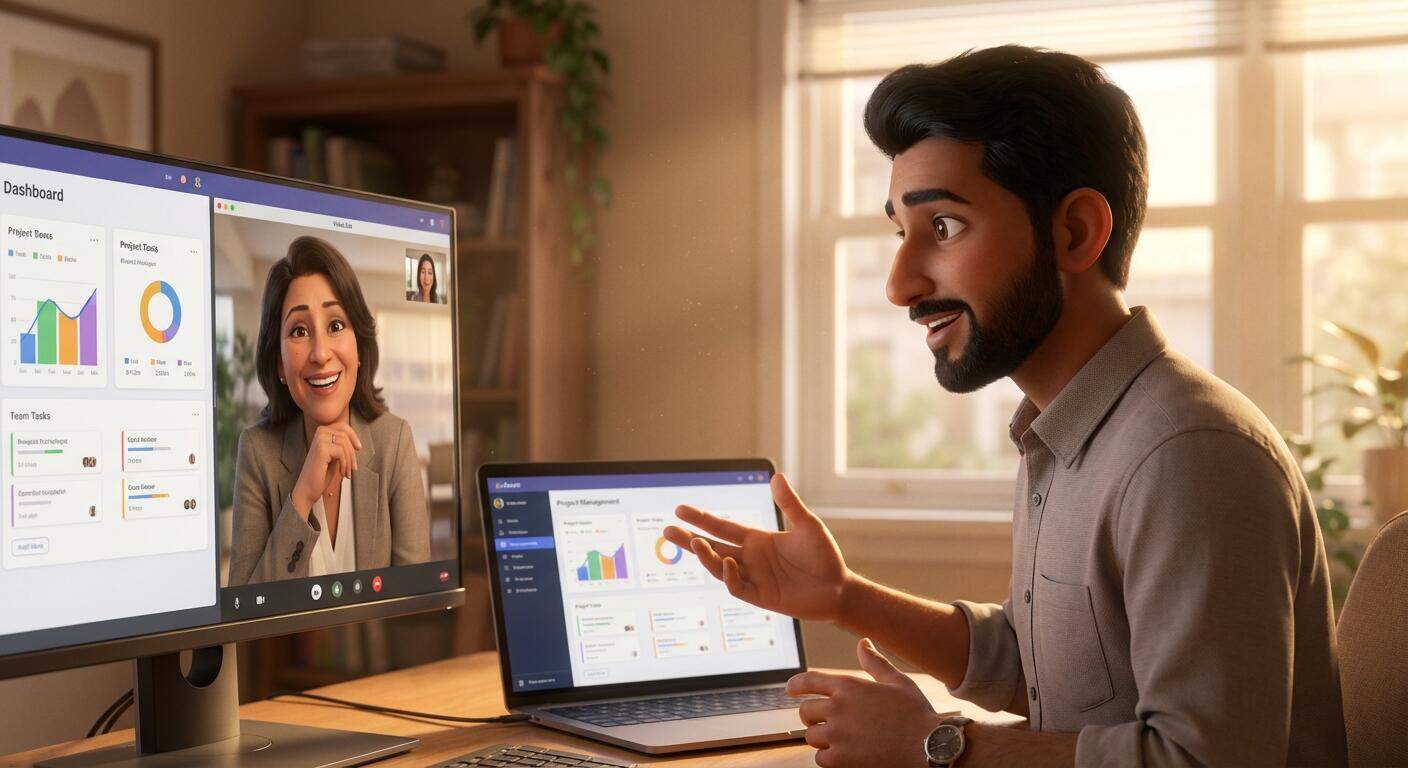
Get Timely, Reliable Updates
Your offshore team will provide clearer progress updates and flag potential obstacles proactively.
This gives you greater visibility into project status, reducing last-minute surprises and allowing for timely intervention before issues escalate into problems.

Develop Stronger Client-Ready Talent
Your offshore team members will develop the polish and presence to represent your company professionally in client interactions.
They'll explain technical concepts clearly to non-technical stakeholders, demonstrate greater executive presence in presentations, and build the kind of client rapport that strengthens your company's reputation and relationships.

Build a Stronger Leadership Pipeline
Your offshore team develops the communication skills, initiative, and business acumen that make leadership potential visible.
The people who are ready to step up will start showing it; taking on greater responsibility, leading effectively, and reducing your reliance on scarce onshore management. Higher offshore ROI for you, clear advancement paths for your distributed team.
These are the outcomes you'll see first.
The ripple effects go further. Your managers spend less time translating and more time on strategy. Your team starts surfacing risks, adapting to ambiguity, and exercising judgment without waiting for direction. That kind of autonomy compounds. We measure the shift with stakeholder surveys before and after. Zero lift on your side.
Explore North America Ready



Your Guide
Meet the Trainer
Meet Your Trainer

Sohail Ahmed
Founder & Lead Trainer
With 25+ years in technology, from engineering at Waterloo to leading distributed teams across India and North America, I've lived the communication challenges of cross-cultural collaboration firsthand. I've seen talented engineers overlooked because they hesitated to speak up, and capable teams underperform because no one addressed the cultural gap head-on.
The frustration led me to build what I couldn't find: a structured program that bridges the specific communication gap between Indian software professionals and North American teams. Not generic soft skills. Not corporate sensitivity training. Practical frameworks grounded in cultural-intelligence research, built for the real scenarios that create friction every day.
Most project managers, product owners, and engineering leads on the North American side recognize the problem. But coaching cross-cultural communication isn't their core job, and it shouldn't have to be. That's the gap I fill, so your people focus on delivering products and projects while their teams communicate with the clarity you need.
As a North American software industry veteran who has worked extensively with teams in India, I built this training for the specific dynamic that exists between these two worlds.
25+ Years
Technology Experience
Cross-Cultural Teams
India + North America
Tested Frameworks
Piloted with Accenture
Root Cause Focus
Applied to Real Work
Got Questions?
Frequently Asked Questions
Everything you need to know about my training programs. Can't find what you're looking for? Reach out to me.
This training is for software professionals based in the Indian subcontinent who work with North American clients and stakeholders. Developers, QA analysts, business analysts, product owners, tech leads, and builders: the people on your team whose soft skills directly affect delivery quality and client/stakeholder relationships.
Our programs go beyond communication training. We address the underlying habits, critical thinking patterns, initiative, and adaptability that shape how your team operates in North American business contexts.
You could, and some managers try. But there are practical reasons most find it difficult to sustain.
First, headspace. Your focus should be on your product, your domain, and the business functions where you add the most value. Designing cross-cultural curriculum and running practice sessions is L&D work. Different specialization. Most managers recognized these gaps years ago. What they lacked wasn't the insight. It was the bandwidth and the specialized toolkit to act on it. Even organizations with dedicated L&D departments rarely have programs built specifically for technology staff from the Indian subcontinent.
Second, sensitivity. Many of these conversations touch on cultural norms, professional identity, and habits shaped by upbringing. Raising these issues directly can feel patronizing or politically charged, especially for managers who don't share their team's cultural background. So the needed conversations rarely take place. The friction compounds.
An independent trainer changes that dynamic. Your offshore team learns and practices in a space where they feel safe being candid. You share the patterns your management layer is seeing with me directly, without putting anyone on the spot. I take what I hear from both sides, generalize it without breaking anyone's confidence, and use it to make the training land where it matters.
Third, visibility. Sometimes the barrier isn't the individual contributors. They want to speak up and take initiative. But a local management layer on the India side enforces traditional hierarchy: don't challenge, don't skip levels, respect the chain of command. That dynamic is invisible from North America, and only surfaces when an independent trainer earns the team's confidence over time.
The result: your team builds these skills faster, you stay focused on what you do best, and nobody has to navigate the discomfort of delivering culturally sensitive feedback up or down the org chart.
You should expect that your offshore team will communicate more directly with your North American stakeholders, raise issues earlier instead of waiting to be asked, creative problem solve with more autonomy, and generally, handle ambiguity with less of the back-and-forth you find necessary today.
The practical impact: fewer miscommunication cycles, less rework, and reduced need for you to act as the go-between on every client interaction. See the full curriculum for module details.
Absolutely. For customized team engagements, I start with discovery sessions with both North American leadership and representative participants in India to understand your specific challenges.
Using my library of established lessons and modules, I can then streamline the curriculum to focus exclusively on the material most relevant to your context. The result is a targeted training program that feels even more relevant to your organization's needs.
Good enough to follow their daily work in English. Requirements documents, team emails, Slack threads, standup meetings. Your offshore team doesn't need perfect fluency. Functional English is the baseline.
A practical screening test you can apply:
If a team member can follow most of what their North American colleagues are saying, even when some context slips past them, they're ready.
From that foundation, we'll rapidly expand their professional vocabulary at the intersection of their technology, their industry, and the business lingo their North American colleagues and clients actually use. That alone closes a surprising number of comprehension gaps with relatively little effort.
If, however, a member of your offshore team still relies on colleagues to translate in meetings, or struggles to read requirements and emails in English, they'll benefit more from more basic English language training first.
This program picks up where that more fundamental language training levels off.
All sessions are delivered live via video conferencing for real-time interaction and group practice. Session recordings are available to registered participants for a limited window after each session, so anyone who misses a class can catch up before the next one.
Between sessions, participants also have access to an AI-powered practice app (or equivalent AI prompts) for reinforcement at their own pace.
The standard North America Ready program runs over 12 weeks: one 2-hour live session per week, plus an optional drop-in Q&A session each week (1 hour) for extra support.
For teams that want a private cohort, I run discovery sessions with your team first to understand your specific challenges. Based on what we find, the curriculum may be shorter or longer than the standard 12 weeks, focused on the modules most relevant to your situation. Whether that's 4 consecutive full days, 6 weeks of half-day sessions (or another arrangement), we'll build a schedule that works for you.
I typically schedule sessions during the natural overlap between mornings in North America (east coast) and evenings in India. Recognizing that this overlap is often your team's most critical window for live collaboration, I'll work with you on a time of day that works for your team.
For concentrated training intensives, I can even accommodate much earlier schedules, including alignment with European business hours, so the training doesn't compete with your core daily syncs.
Private cohorts work best with groups of 6 to 20 participants. Smaller groups allow for more personalized attention, while larger groups benefit from richer peer practice and diverse perspectives. For teams outside this range, reach out and we'll find the right format for you.
Pricing depends on team size, customization level, and program format. The best way to get started is to book a discovery call where I can scope what's right for your team.
My prototyping cohorts are currently heavily discounted to help refine the program.
After the initial cohorts, pricing will be $2,250 USD per participant of the live, cohort based North America Ready program.
Still have questions?
Get in touchSatisfaction Guarantee
I stand behind the value
of this training.
100%
After the first four sessions, we hold a mandatory checkpoint with your leadership teams in both North America and India. If your team isn't seeing the value at that stage, you can cancel the rest of the engagement.
You'll only pay for the initial discovery and customization phase; the training sessions you received will be fully refunded.
I only partner with organizations that are getting real value from the experience.